
Throughout 2025, we attended and analysed four major international congresses to identify the signals that matter most for beauty innovation.
1. SENSORY CONGRESS 2025

1. Emotions enter product validation
Lucas Meyer (Pickmulse™) presented a surfactant-free quinoa starch emulsifier designed to deliver a powdery, cushion-like sensoriality, supported by data linking texture perception to activation of reward-related brain regions (skin–brain approach).
In parallel, Mustela / Expanscience demonstrated that texture comfort and reassurance can be quantified as emotional outcomes, alongside classical efficacy endpoints.
2. Emotions are built through multiple channels / multisensory
Across the studies presented at this congress:
- Touch and texture emerged as primary drivers of comfort and reassurance, particularly in infant care contexts (Mustela).
- Scent played a central role in shaping identity, soothing effects and arousal states (Odournet).
- Visual cues and texture influenced expectation formation prior to application (Actalia Sensoriel).
- Application rituals, including self-touch and care gestures, actively contributed to emotional experience.
3. First sensory seconds shape perceived efficacy
Poster winner Céline Lucas, from Actalia Sensoriel presented a sensory study analyzing the first seconds of product application to identify which early sensory cues (texture, touch, scent, visual appearance) most strongly influence perceived efficacy. Results showed that “feeling effective” precedes biochemical efficacy, underlining the strategic importance of first-second sensory design.
4. Neuroscience tools are operational
EEG, implicit language scoring, emotional AI were presented as mature tools able to discriminate between close product variants, scalable and increasingly cost-accessible for R&D and innovation projects.
These tools were positioned as an additional interpretative layer, complementing classical sensory and quantitative tests rather than replacing them.
5. Sensory perception anchored in biology
Coty focused on fragrance performance and perception using ex-vivo study (with pig skin models), showing how parameters like skin hydration and lipid content influence fragrance diffusion and perceived absorption
Meanwhile URCOM presented a study measuring friction and spreading during product application, linking these physical measurements to tactile perception (drag, smoothness, melting) across different skin states.
2. IN-COSMETICS GLOBAL 2025

1. Emotion, experience, personalization and meaning shift from “nice-to-have” to value driver
Eurofragrance translated fragrance concepts into emotional worlds through concrete multisensory activations: perfumes paired with specific mood universes (for example uplifting, comforting, escapist), supported by mood-inspired mocktails, and a DJ translating fragrance accords into live music.
This focus on emotion was echoed at the ingredient level, as Mibelle Biochemistry (TiMood, etc.) exemplified a new generation of neurocosmetics with actives explicitly framed around mood and emotional state, supported by tools designed to visualise subconscious response.
In parallel, Symrise framed its ingredient innovations through a sustainability and protection narrative, linking concrete launches (Symrelief Green for skin soothing, Crinipan for scalp care) to Mindera, its framework explaining how natural ingredients can still deliver strong performance, thereby turning abstract concepts like naturality × efficacy into meaningful value for brands and consumers.
2. Sensory experience & texture innovation as immediate evidence of benefit
Lucas Meyer Cosmetics by Clariant showed demo formulations where texture alone communicated comfort, wellbeing or perceived efficacy, reducing the need for complex explanation. For example: The Impassivity Cream (cushion-feel comfort) and the Modulating Face Essence (cashmere-skin texture linked to mood and anti-stress benefits)
Meanwhile, Luzi built its presence around the “OFF FIRE” theme, using strong sensory contrasts between heat and cold (warm vs icy olfactory sensations) to physically trigger the senses and anchor fragrance innovation in immediate, felt experience rather than technical discourse.
3. Ingredient innovation reframed around time: longevity, long-term value
PRO-LONGEVIA® by Solabia, PrimalHyal™ UltraReverse by Givaudan, and Damasty® by Robertet were positioned less on short-term effect and more on longevity, ageing mechanisms and sustained skin health, reflecting a temporal shift in beauty narratives.
Moreover, sustainability (upcycling, biotech, fermentation) was embedded as part of this long-term value logic, not as a standalone claim.
3. PANGBORN 2025

1. Emotions increasingly studied beyond what consumers say
At Pangborn 2025, several contributions highlighted the limits of traditional questionnaires in capturing emotions. Instead, researchers increasingly relied on implicit methods, observing automatic reactions (such as reaction time, spontaneous choices and behaviour) rather than declared answers alone.
In this context, DSM-Firmenich (Christe Copyright TSTLablle Porcherot) introduced an implicit fragrance evaluation method combining ratings with reaction time to measure emotions such as cleanliness and serenity, showing that “Serene & Clean” scents significantly increased perceived calm and cleanliness compared to controls.
2. AI used to model sensory and emotional data
In parallel, AI and advanced data analysis were increasingly used to build models, identify patterns and handle complex sensory and emotional datasets, moving beyond descriptive statistics toward data-driven modelling and prediction.
Mane illustrated this shift with an AI-driven approach combining real-time Voice of the Consumer data with implicit association measures to identify core consumer motivations (Jobs to Be Done), helping explain not only preference, but also why products are chosen and repurchased.
3. Towards a new product development logic: memory, multisensoriality, and real-life experience over time
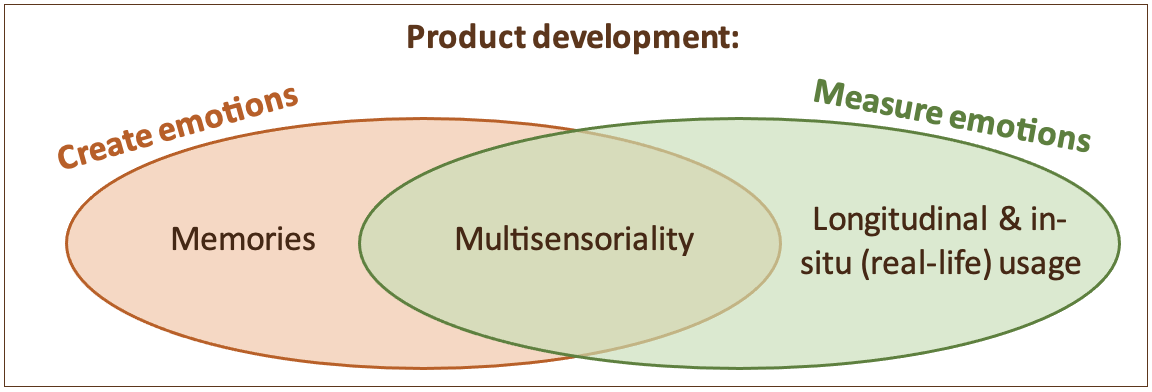
At Pangborn, research converged on three complementary pillars for product development: memory, multisensoriality and longitudinal / in-situ usage.
First, memory emerged as a central driver in designing products that deliver long-lasting pleasantness, liking and positive emotions.
Second, multisensoriality was shown to be both a creation lever and a measurement framework for emotional benefits. Several studies made this shift explicit, showing that emotional response cannot be understood by isolating one sense at a time. Instead, combined sensory experiences (sound, colour, scent, texture, and context) were shown to be essential for product development.
Finally, longitudinal designs and real-life usage contexts, such as repeated use or in-salon testing for hair products, were increasingly used to capture emotional dynamics over time and bridge the gap between lab-based testing and lived consumer experience.
Several studies illustrated this shift from immediate perception to long-term experience:
- The Smell & Taste Lab, in collaboration with Estée Lauder Companies and TU Dresden, compared fragrance perception (liking, familiarity, mood impact, and odor memory) in women with and without mild depressive symptoms across 16 fragrances. Smell performance was similar, but odor memory differed, reinforcing memory as a key driver in fragrance design.
- L’Oréal further illustrated the role of memory through work on lipstick closing sounds, combining physical measurements, sensory evaluation and cognitive interpretation to show how packaging sound contributes to perceived quality and emotional response. The same group also presented work on incidental learning and memory of cosmetic cream odors, highlighting how emotional valence, intensity and individual differences shape odor memorization and long-term pleasantness.
4. IFSCC 2025
1. Emotional, cognitive, and multisensory science remain central topics
A common thread emerging across the previous congresses was the continued importance of multisensory perception in emotional and cognitive sensory science. This was reflected in a workshop by David Morizet (L’Oréal), which explored how smell, sight, touch, and sound interact with formulas and packaging to shape emotional responses, memory, identity, and behavior in beauty routines.
This focus on memory was further reinforced by a poster by The Smell & Taste Lab, with Estée Lauder Companies and TU Dresden, showing how perfumes act as powerful triggers of odor memory, underscoring memory as a key driver of emotional response and fragrance experience.
2. Rise of holistic beauty: health, beauty-from-within, longevity, well-ageing
IFSCC strongly reflected the rise of holistic beauty, with innovation focusing on biological ageing mechanisms, resilience and long-term skin health, rather than immediate visible effects. Photoprotection (a major topic in IFSCC this year), senescence, exposome and cellular sciences were central to this shift.
Jing Qu (Chinese Academy of Sciences) presented a multidimensional ageing clock that estimates “how old your body is on the inside” (not just your calendar age), pointing toward beauty-from-within approaches tailored to each person’s biological ageing.
In parallel, Givaudan identified “neuro skin ageing,” showing that ageing alters communication between sensory neurons and keratinocytes, impacting touch perception, sensitivity and barrier function. This moves the conversation beyond “anti-wrinkle”, to long-term comfort and resilience.
3. Innovation shifts from siloed disciplines to multidisciplinary and system-level thinking
Product innovation being increasingly driven by holistic beauty and health sciences, it needs to integrate biological, cognitive, sensory, physical, and environmental approaches. Interactions between skin biology, microbiome, material properties (texture, colour, optics), delivery systems (encapsulation, etc.) and environment are treated as design inputs, and no longer as downstream constraints
This multidisciplinary shift was illustrated in IFSCC by RAHN AG, which leveraged nutrition and physiology research in topical skincare, resulting in a “cosmetic energy drink for the skin.”
More broadly, this evolution was reflected in the strong presence of open innovation across the congress.
4. Data, AI and modelling support complexity, not simplification
Finally, the congress showed how AI is increasingly used to manage multidimensional biological and sensory data, supporting predictive and personalized innovation.
Amorepacific illustrated this approach with an AI-driven skin prediction algorithm integrating genetic, phenotypic, and lifestyle data to guide personalized routines and long-term skin benefits.
HOW TO INNOVATE IN THIS LANDSCAPE?
Across Sensory Congress, In-Cosmetics, Pangborn and IFSCC, one thing is striking: beauty innovation is accelerating, and getting more complex by the day. Biology, multisensory perception, cognitive science and emotions, AI and longevity are no longer separate conversations. They’re colliding.
1. GATHER INSIGHTS
Innovating today starts with knowing what’s happening: keeping track of fast-moving scientific and market advances, and understanding how they connect across disciplines. This is where TSTLab’s Competitive Watch helps teams stay oriented and focused on what truly matters.
2. OPEN UP TO OPEN INNOVATION
Innovation rarely happens alone, especially in this increasingly multidisciplanary landscape, as showed the congresses. Through a broad academic, industrial and technological network, TSTLab helps connect the right ideas with the right partners and people, at the right moment.
3. BACK YOUR IDEA WITH ROBUST SCIENCE
Innovation moves forward when ideas are translated into concrete projects. TSTLab supports formulation, product development and R&D projects (end-to-end or partially), from early ideation to implementation. Helping teams structure programs, interpret complex data, and make informed decisions along the way.
What makes this approach work in practice is having both depth and agility.
At TSTLab, our work is grounded in a strong scientific backbone, with more than 30 scientific publications and deep expertise in cognitive and multisensory sciences, emotions, wellbeing and neuroscience, applied to cosmetics, fragrance and health.
At the same time, we bring a solid understanding of business and marketing, so insights don’t stay theoretical.
Operating as an agile structure, we engage quickly, act flexibly, and work closely with teams. And through a broad academic, industrial and technological network, we help connect companies, partners and people, enabling the right collaborations at the right moment.
This is why TSTLab acts as a 360° innovation partner: helping teams absorb complexity, shape ideas, and turn them into robust studies, R&D programs and products that make sense scientifically and strategically.
Wondering what this means for your next project? Reach us at contact@tstlab.com